The 4A Model: Why Sequence Matters More Than Speed in Equity Work
In 2020, organizations across North America made ambitious commitments to equity. Statements were published, budgets were approved, and training calendars filled up quickly. Six years later, many of those same organizations are still asking the same question: Why didn't the training lead to lasting change?
After working with boards, hospitals, trades organizations, and government teams, I've found the answer is rarely a lack of commitment. More often, it's a matter of sequence. We call it the Activity Trap.
It usually looks something like this: an organization hosts a bias workshop in March, celebrates heritage months throughout the year, launches an employee resource group, and then wonders why little has changed by December.
When equity initiatives are introduced as a series of disconnected activities, employees begin to see them as events rather than practices. The work becomes something the organization does occasionally, not something it consistently builds into its culture.
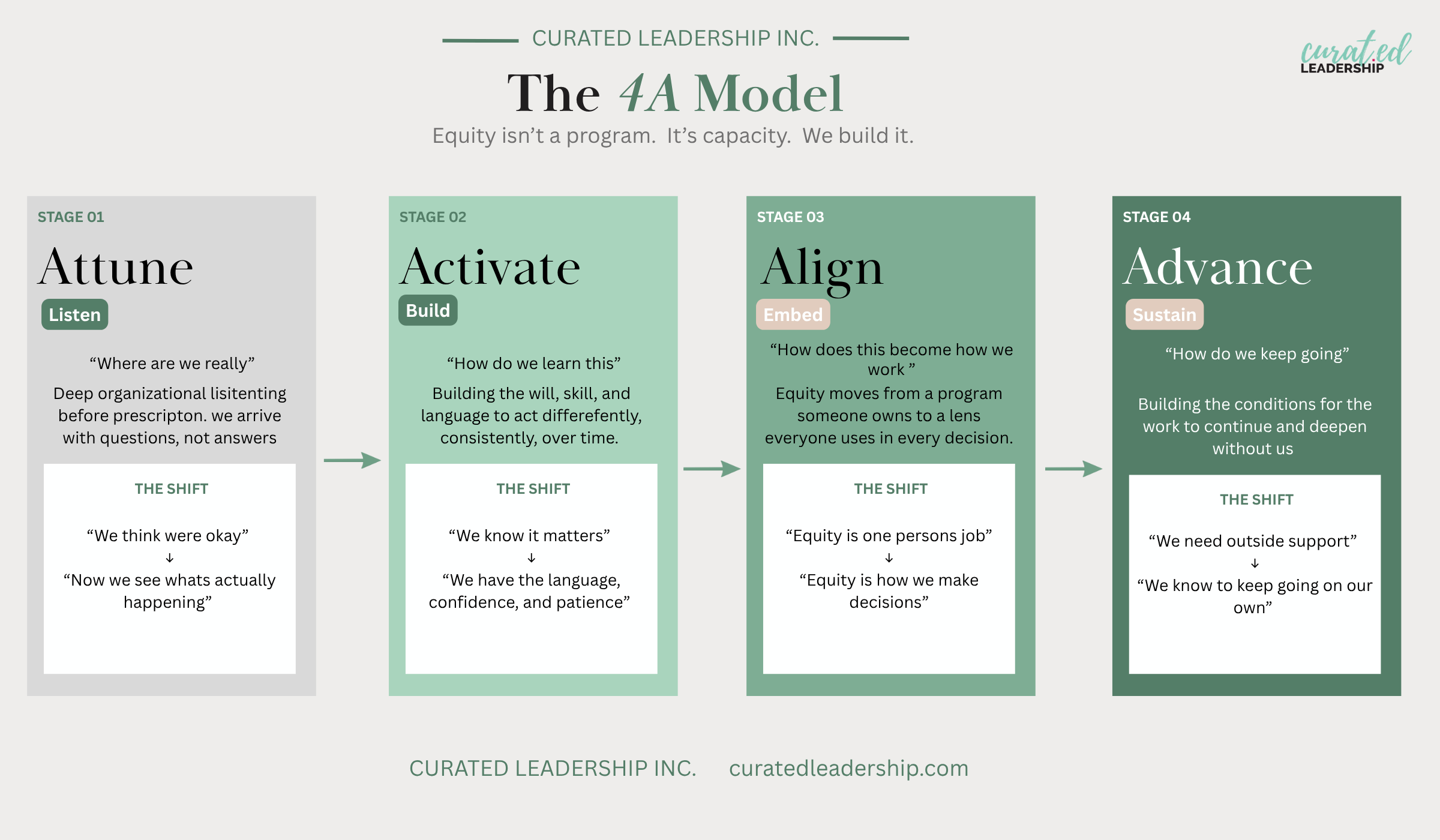
The solution isn't to add more activities. It's to focus on the right activities, introduced in the right order and at the right level of depth. That's the thinking behind the 4A Model, the framework that guides all Curated Leadership engagements.
Attune: Understanding Before Action
Many organizations begin their equity journey with awareness-building. They update terminology, review data, and introduce new concepts. While awareness matters, information alone rarely changes behaviour.
People change when they develop a deeper understanding of how their own actions, influence, and decision-making affect others. That's where my theatre background often comes into play.
Through role play, facilitated scenarios, and structured reflection, leaders have the opportunity to experience how exclusion operates in real-world situations. Together, we examine questions such as: Who gets interrupted? Whose ideas receive recognition? Who consistently takes on invisible labour?
These moments move learning beyond theory. They create understanding that people can feel, remember, and apply.
Activate: Moving from Awareness to Skill
There's a significant difference between caring about an issue and knowing how to respond when it appears in front of you. Without practical skills, awareness can actually create hesitation. People recognize a problem but aren't sure what to do next.
That's why this phase focuses on building leadership capacity through practice.
One of the key skills we teach is Calling-In. While Calling-Out often centres on criticism and public correction, Calling-In creates space for accountability while maintaining the relationship. The difference can be as simple as saying:
"That was offensive" versus "I'd like to share how that landed for me, because I don't believe that was the impact you intended."
These conversations take practice. Through rehearsal and guided feedback, leaders and employees build the confidence to navigate difficult moments effectively when they arise.
Align: Ensuring Systems Support the Work
Here's an uncomfortable reality: even the most aware and capable leaders will struggle to create change if the systems around them reinforce the status quo. Misalignment often shows up in subtle ways. Hiring processes reward "culture fit”, promotions rely on informal sponsorship networks, and meeting norms consistently favour the loudest voices in the room.
When these systems remain unchanged, they can quietly undermine even the strongest training efforts.
Alignment means examining the policies, processes, and decision-making structures that shape everyday experiences within an organization. It requires identifying where stated values and operational reality no longer match.
This is the focus of our Curated EDI Audit. While it may not be as visible as a workshop or training session, it is often where some of the most meaningful and lasting change takes place.
Advance: Making Progress Sustainable
Before investing in equity work, every leader should ask a simple question: How do we ensure the progress lasts?
Advancing the work means building in measurement, accountability, and ongoing momentum so that progress can withstand leadership changes, shifting priorities, and budget cycles. It's one of the reasons we position ourselves as long-term strategic partners rather than one-time trainers.
Real transformation isn't a single event. It's the result of systems, habits, and structures that support change over time.
What the 4A Model Means for Organizations Today
Many organizations are currently re-evaluating their approach to culture, leadership development, and DEI. Some are questioning what has worked. Others are deciding where to focus limited resources. Wherever your organization sits, these four questions can help clarify the next step:
Attune: Do your leaders understand exclusion intellectually, or do they recognize how it operates in practice?
Activate: When bias appears in a meeting or workplace interaction, do people have the skills to address it constructively?
Align: Do your hiring, promotion, and feedback systems reflect the values your organization promotes?
Advance: If your strongest champion left tomorrow, would the work continue?
If any of these questions made you stop and think, that's valuable information! To support that process, I've created a free five-minute Equity Capacity Assessment. It helps organizations understand where they currently sit within the 4A Model and highlights the areas most likely to create meaningful progress.